
There is a moment in late summer when the drakes seem to vanish from the lake. The Mallard that spent spring showing off a bottle-green head now looks brown and streaky. The Shoveler's chestnut flanks have gone, and the Teal has become a smudge of mottling by the reeds. Nothing has flown off and nothing has died. The males have moulted into eclipse plumage, and for a few weeks the brightest birds on the water become the hardest to identify. What follows is a practical comparison of the two plumages, when each appears, and how to work out what you are looking at.
What Eclipse Plumage Actually Is
Feathers wear out. Sunlight, abrasion and the daily work of flying and swimming grind the edges away, and the only repair available to a bird is replacement. Most birds moult once a year; many ducks moult twice, and that second moult produces eclipse plumage.
Eclipse is a short, dull, female-like plumage worn by drakes after the breeding season. In a typical dabbling duck such as Mallard, the year runs like this: breeding plumage through winter and spring, eclipse from early summer into autumn, then a partial moult back into full colour before winter courtship begins.
Two features make eclipse distinctive. First, it coincides with the complete moult of the flight feathers, so for roughly three to four weeks a drake cannot fly at all and skulks among reeds or sits far out on open water. Second, it is genuinely confusing. A drake in eclipse is far closer in tone to a female than to his own breeding self, and only a handful of fixed features give him away.
Timing: A Year in a Drake's Feathers
The exact dates shift with species, latitude and weather, but the pattern across Britain is reasonably consistent.
- Winter and early spring: full breeding plumage. Pair bonds in many dabbling ducks form in autumn and winter, so this is the plumage that does the work of courtship.
- Late spring: the breeding attempt ends and the moult begins. Drakes start to look scruffy as dull brown body feathers come through.
- June to July: flight feathers are dropped almost simultaneously. Ducks become flightless, often gathering on quiet gravel pits, reservoirs and estuaries.
- July to September: peak eclipse. Most drakes on your local patch will look like females.
- September to November: a partial moult restores colour to the head, breast and flanks. The wing feathers are not replaced again.
- November onwards: breeding plumage is back, in time for winter display.
Eclipse rarely runs to a neat schedule. Some birds finish early, some late, and a drake moulting for the first time can look stranded between two plumages for weeks.
Breeding and Eclipse Plumage, Side by Side
Breeding plumage
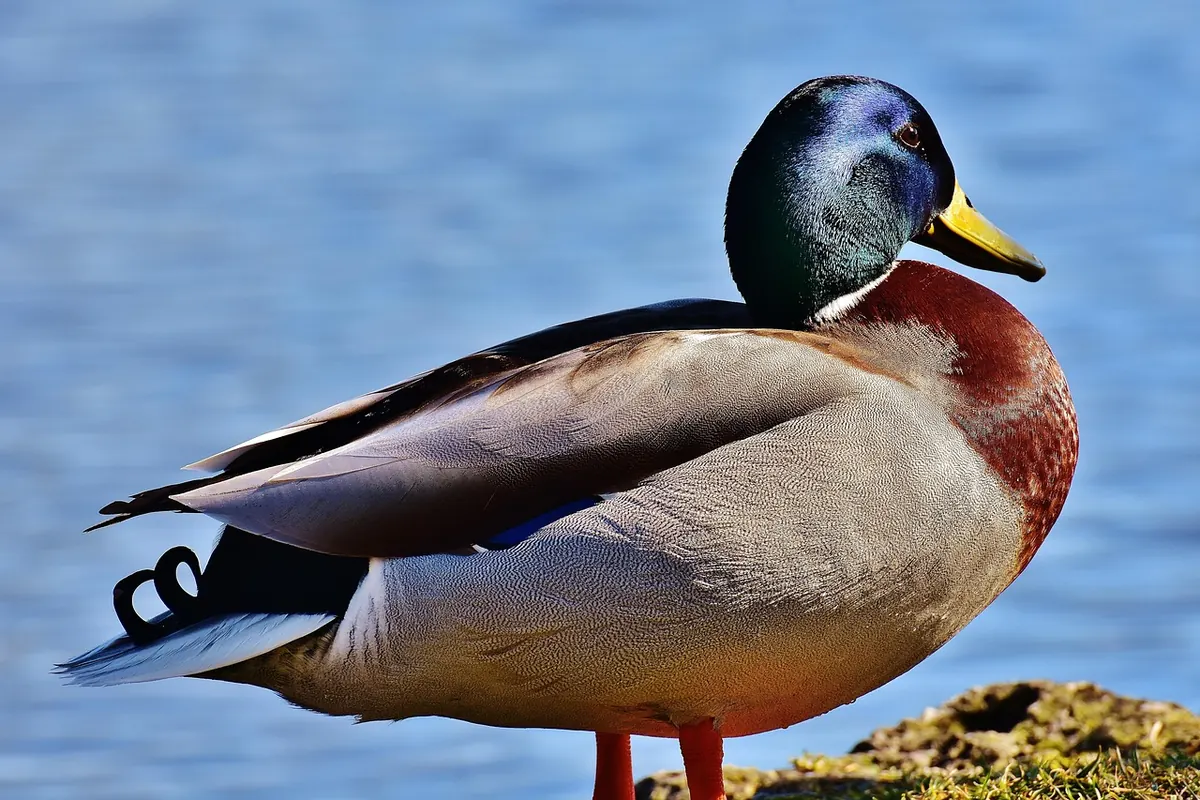
This is the plumage most people picture when they think of a duck. Colours are saturated and contrasts are bold: green head gloss on Mallard, chestnut and green on Teal, white flanks on Goldeneye and Tufted Duck. Bills and eyes are at their most vivid, and patterned feathers on the flanks and scapulars are fully exposed. Because it is worn through the winter and early spring, breeding plumage is what most field guides illustrate first.
Eclipse plumage
Eclipse is built for concealment rather than display. The body becomes a mix of browns and grey-browns, finely streaked and mottled, with an overall tone that matches dead reed stems and muddy water. Head gloss fades or disappears and elongated feathers such as a drake's neck tuft or crest shorten noticeably. Look at a drake Mallard in eclipse from thirty metres and you will write down "female".
What stays the same
- Bill: colour and shape usually persist, so a yellow-olive Mallard bill still means drake, and a Shoveler's black bill against a female's olive one is a reliable clue.
- Eye: iris colour is a strong pointer in several species, including the yellow eye of a drake Shoveler.
- Wing: the speculum — the coloured patch on the folded wing — keeps its colour and borders, though it may look duller when worn.
- Undertail coverts: the drake Mallard's black undertail remains black, standing out against a brown body.
- Structure: drakes are usually larger, longer in the body and heavier in the bill than females of the same species.
- Legs and feet: sometimes brighter in males, though this is hard to judge on a swimming bird.
Identification Tips for Brown Ducks
Work through these checks in order. The first two will settle most birds on their own.
- Start with the date. Between July and early September, assume any dull duck could be a drake. This single habit prevents most mistakes.
- Go straight to the bill. Before you look at the body, look at the head and bill. Colour, length and any pattern on the bill itself are the least changeable features a duck has.
- Check the eye. Bright irises on a brown duck are a strong hint of a male in eclipse.
- Find the speculum. A folded wing often shows a patch of colour that a female would not carry so strongly.
- Read the face. Females typically show a dark line through the eye and a pale patch at the base of the bill. Eclipse drakes tend to have a darker, more uniform crown and a less clearly striped face.
- Look at the rear end. Undertail coverts, flank patches and the shape of the tail can be revealing, especially on a bird stretching or preening.
- Judge the jizz. Size, neck length and bill proportions are worth trusting when plumage is unhelpful.
If a brown duck in July has a yellow-olive bill, a dark crown and black undertail coverts, you are looking at a drake in eclipse — not a female.
When It Isn't Eclipse
Not every dull duck is a drake in disguise. Juveniles appear from mid-summer onwards and look soft and loosely feathered, with a duller speculum and often a paler bill than adults. They keep that look through their first autumn, so a scruffy brown duck in September may simply be a young bird of the year.
Females do moult, but their body plumage stays cryptic year-round, so they never show the dramatic swing you see in drakes. That is the whole point of the two plumages: the female is camouflaged in every season, while the male is camouflaged only while he is flightless and vulnerable.
Geese and swans sit differently again. Greylag, Canada and other geese moult all their flight feathers at once and are flightless for a few weeks in summer, gathering at traditional moulting waters, but the sexes look much alike and there is no separate eclipse plumage. Mute Swans follow the same pattern, losing flight feathers in mid-summer and taking several weeks to regrow them. Shelduck are a special case: many British birds leave to moult in the Wadden Sea, and the drake keeps his bill knob throughout.
Watching Moulting Waterfowl Without Causing Harm
A flightless duck cannot escape you, which makes summer the season for good fieldcraft rather than close approach. Watch from the bank with binoculars or a scope, keep dogs on a lead near moulting lakes, and avoid walking the shoreline of a quiet pit where birds are sitting out. Pressing a flightless bird onto the water costs it energy it cannot easily replace.
Make a note of what you see. A short summer diary of one local lake — counts, dates, which drakes still show colour — will teach you more about plumage than any illustration, and by October you will have a clear picture of how the change works on your own patch. If a duck is still unable to fly long after the others have moulted out, it may be injured or oiled; contact a local wildlife rescue rather than attempting to handle it yourself.
Photo: Alexas_Fotos / Pixabay
Related posts
More stories you’ll love reading