
A blue tit's crown and a kingfisher's back can look almost the same shade of blue, yet neither contains a single blue pigment. That contradiction sits at the heart of bird colour. Feathers make colour in two very different ways: some hues come from pigments that absorb certain wavelengths of light, while others are produced by microscopic structures that scatter light back to your eye. Most of the colours you see in a garden are a mixture of both, layered in ways that still keep researchers busy.
What we mean by colour
Colour is not a property of a feather so much as a conversation between the feather and light. White light arrives containing every wavelength. A pigment absorbs some of those wavelengths and reflects the rest; whatever reaches your eye is the colour you perceive. Structural colour works differently. Instead of absorbing light, tiny repeating structures inside the feather interfere with it, reinforcing some wavelengths and cancelling others. Change the angle of view and the colour can change with it.
For birds, colour is rarely decoration alone. It signals species, sex and condition, and it often does so in wavelengths we cannot see. Many birds are sensitive to ultraviolet light, which means a plumage that looks plain to us may carry hidden patterns to them.
Pigments: the chemical route to colour
Three main pigment families account for most of the colour birds make. They differ in where they come from and how stable they are.
Carotenoids
These produce the yellows, oranges and reds of tits, finches, woodpeckers and flamingos. Birds cannot manufacture carotenoids themselves; they must obtain them from food, then modify them. That dietary link matters. A male great tit with a rich yellow breast has been eating well and processing those pigments efficiently, so the colour acts as an honest signal of condition. Carotenoids also fade. A feather grown in late summer may look duller by spring, which is one reason many birds moult before the breeding season.
Melanins
Melanins give black, grey, brown, rufous and buff tones. Unlike carotenoids, they are synthesised inside the feather follicle, so a bird does not need a special diet to make them. Eumelanin produces blacks and dark browns; phaeomelanin produces warmer reddish-browns. Melanin granules also strengthen feathers, which is why wingtips and outer primaries are so often black. Heavy melanin at the feather edge resists abrasion, a useful trick for a bird that flies thousands of miles.
Porphyrins and psittacofulvins
Porphyrins create the pink, brown and green tones seen in owls, bustards and some other groups. They are unusual in being fluorescent under ultraviolet light, and they break down in sunlight, so these colours tend to be found in feathers that are hidden or short-lived. Parrots use a separate family entirely, psittacofulvins, which produce their reds and yellows without any help from diet.
Structural colour: when the feather itself does the work
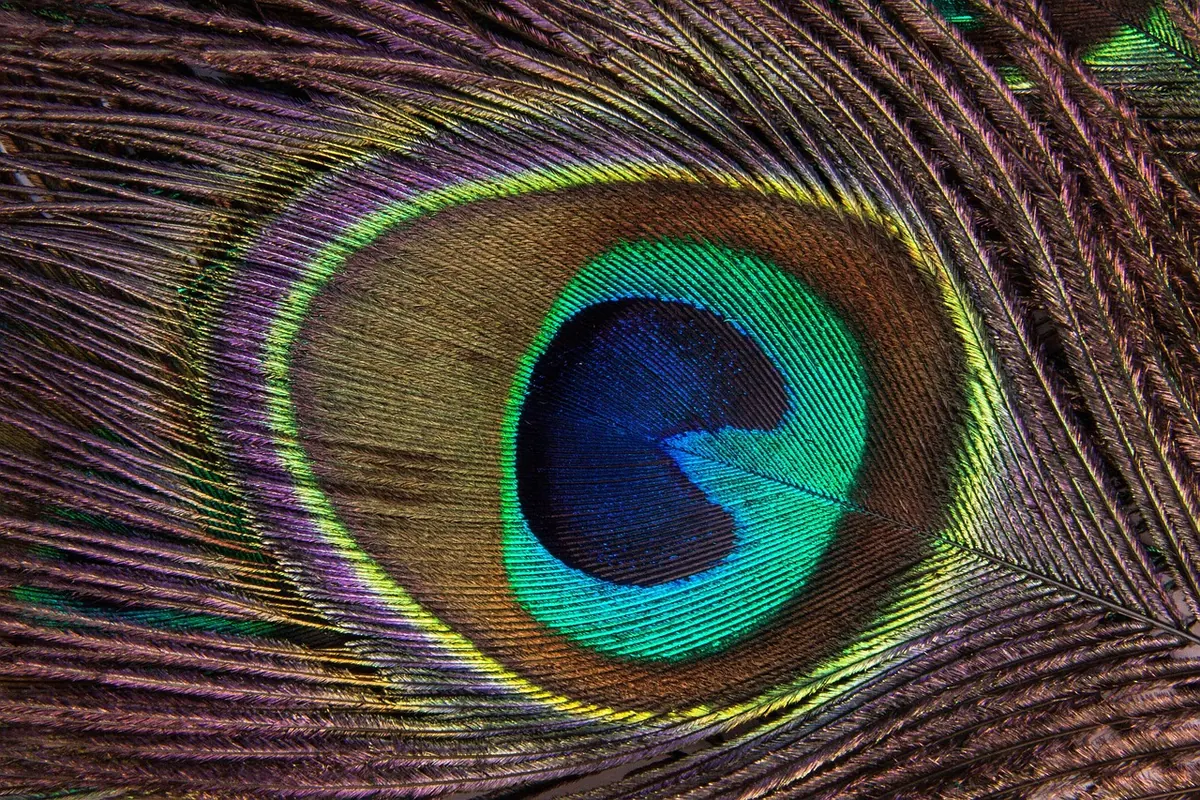
Structural colours are the ones that make people stop and stare. Inside the feather barbs, keratin and air are arranged in repeating patterns on a scale close to the wavelength of visible light. Light bouncing through these layers interferes with itself. Wavelengths that line up reinforce one another and reflect strongly; the rest cancel out.
Non-iridescent blues and greens, such as those of jays, blue tits and many parrots, come from this kind of scattering. The blue looks the same from almost any angle because the nanostructure is disordered but still regular enough to favour short wavelengths. Open a blue feather and hold it against the light and the blue usually vanishes, because the scattering depends on light coming from the front.
Iridescence: colour that moves
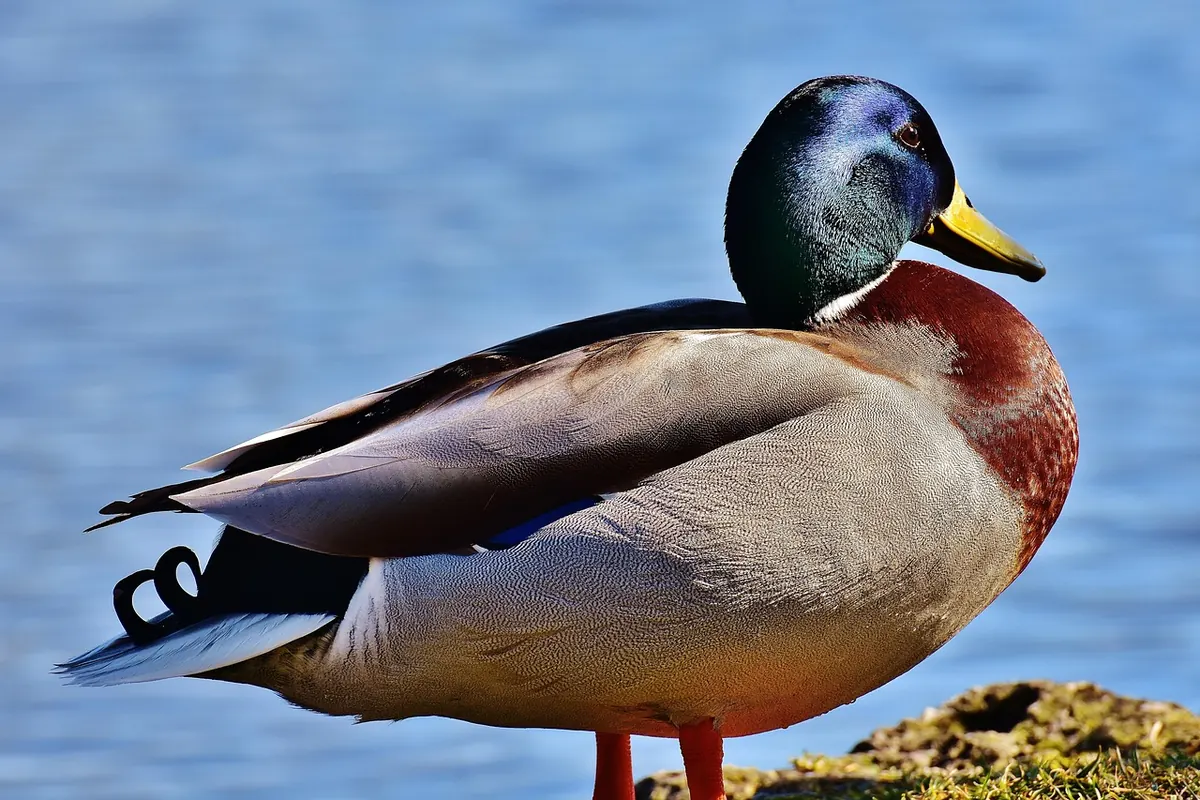
Iridescence is structural colour with a strong sense of direction. Hummingbirds, peacocks, grackles and many ducks have neatly stacked layers in their barbules. Which wavelengths reflect depends on the angle between the light source, the feather and your eye. Tilt the bird and the colour shifts through greens, blues and purples.
That angle dependence is easy to miss in photographs, which is why museum specimens of hummingbirds can look disappointingly dark. In life, a hummingbird turns its whole body to flash a signal at a rival. The colour is not on the feather; it is in the geometry.
When pigments and structure combine
Pure pigment or pure structure is the exception. Most plumage is a collaboration, and the layers are stacked like a stage set. A few familiar examples:
- Green. Often a yellow carotenoid pigment sitting over a blue structural layer. The blue scatters, the yellow filters, and the eye reads green.
- Deep blue. Structural blue combined with a melanin layer underneath. The melanin absorbs stray light, so the blue appears richer instead of washed out.
- Olive and bronze. A thin melanin layer over a structural colour can shift it towards olive, bronze or teal.
- White. No pigment at all; the feather is full of air, which scatters all wavelengths equally.
This layering explains why feather damage changes colour so obviously. Once the barbules separate, light behaves differently, and a glossy iridescent patch can turn dull brown. Wear is not just cosmetic; it is optical.
How to look at colour properly
Colour is easy to enjoy and surprisingly easy to misread, so it pays to look with a little method. Try these when you are out with binoculars or examining feathers at home.
- Move around the bird, or move the feather. If the colour shifts, structure is doing the work. If it stays put, you are most likely looking at pigment.
- Use a hand lens or a macro mode on a camera to see barbs, barbules and the fine pattern of colour at close range.
- Compare the same species in sun and in shade. Structural colours dim sharply out of direct light; pigment colours hold up better.
- Backlight a moulted feather against a window. Blues and greens often disappear, while reds and yellows usually remain.
- Watch plumage through the year. Fading and wear tell you how a colour was made long before any laboratory test does.
Reading colour in the field
Once you start treating plumage as a layered optical system, identification gets easier. A dull bird in autumn is not necessarily a different bird to the bright one you saw in spring; it may simply be a feather generation older, with pigments faded and barbules worn. Photographs flatten the effect of angle, so trust your eyes over a screen. And keep in mind that what you see is only part of the story: in ultraviolet, a modest brown bird can carry markings that decide which rival wins a territory and which mate is chosen.
Next time a starling catches the light at a petrol station forecourt and flares through green, purple and oil-slick bronze, you are watching keratin, melanin and geometry working together. Nothing is added and nothing is painted. The colour was always there in the structure, waiting for the right angle of sun.
Photo: alicepaipai / Pixabay
Related posts
More stories you’ll love reading